


Gokyo Lakes Trek
14 days • Small group • Private option available • Pickup available
Difficulty:Medium to Hard
From$1,399

Call us, we are at your service
 View more photos
Price includes round-trip flights, permits, guide, porter, meals, teahouse lodging , and 2 nights’ accommodation in Kathmandu.
This trip is fully customizable
The ultimate circuit around the Everest region! Above and Beyond Trekking takes you on the epic Everest Three Passes trek! Crossing three passes above 5,300 m / 17,389 ft: Kongma La, Cho La, and Renjo La, this trekking route links the Everest Base Camp trek with the Gokyo Lakes trek, forming a loop that avoids backtracking. Instead of trekking in and out on the same path, the three passes let you move from one valley to the next, seeing the massif from every angle! Most trekkers who come to Khumbu only see Everest from one side. This Everest Three High Passes trek shows you all of them!
The trail begins with the classic approach through Namche Bazaar and Tengboche to Dingboche. From there, the Everest Three Passes trek diverts from the standard EBC trail and heads to Chhukung before crossing Kongma La (5,535 m / 18,159 ft), the highest of the three passes. The trail then visits Everest Base Camp and Kala Patthar before turning west over the second of the three passes, the Cho La (5,368 m / 17,611 ft) into the Gokyo Valley. After climbing Gokyo Ri for a panoramic view of four +8,000‑meter or +26,247-feet peaks, the final pass, Renjo La (5,360 m / 17,585 ft) drops you into the quiet Thame Valley for the trek back to Namche Bazaar. Each pass is a full day of trekking, with steep ascents and long descents across snow, rock, and glacier moraine, promising you a true Himalayan experience!
Above and Beyond Trekking recommends this 19‑day Everest Three Passes trek for those who already have high‑altitude experience and want a proper challenge. This is not a beginner's route. The days are long, the air is thin, and the terrain is rough. But for those who are ready, the reward is a complete tour of the Everest massif; Base Camp, the lakes, the passes, and views that change with every turn!
Considered more as a challenging to strenuous trek, it is more demanding than the standard Everest Base Camp trek. You’ll require excellent fitness, stamina, and previous high‑altitude experience. The trek involves crossing three passes above 5,300 meters or 17,389 feet, with long trekking days (up to 10 hours) on steep and rough terrain. This trek is recommended for experienced trekkers.
The Three High Passes Trek is a loop circuit that avoids backtracking, while the EBC trek is an out‑and‑back route. This trek adds three high passes (Kongma La, Cho La, and Renjo La), two additional high viewpoints (Gokyo Ri and Kala Patthar), and the Gokyo Lakes. It is significantly more challenging and requires better fitness, but it offers a more complete and varied experience of the Everest region, with less crowds and more views!
You’ll need a Sagarmatha National Park entry permit and a Khumbu Rural Municipality permit. These can be obtained in Kathmandu. Above and Beyond Trekking arranges all permits as part of the package included within the price.
Pack light but include warm layers for the higher elevations, waterproof clothing, sturdy hiking boots, a sleeping bag (rated to -10°C or lower), a headlamp, sunscreen, and a first‑aid kit. You can find warm blankets at the teahouses but using your sleeping bag will be more comfortable. Essential items include a down jacket, fleece layers, thermal underwear, waterproof jacket and pants, warm hat, gloves, and sunglasses with UV protection. Your guide can provide a detailed packing list before the trek. The trick is to wear layers of clothing easily adjustable to the switching temperatures!
Absolutely. Here’s a smoother, more natural version while keeping your original meaning: During your stay in the mountains (Lukla to Lukla), you’ll stay overnight in traditional and simple teahouses or lodges. These family-operated mountain accommodations offer tired trekkers a place to rest, sleep, wash, and eat. Throughout the trek, you’ll visit various teahouses and spend many nights there. The higher you go, the simpler the accommodations become. At lower elevations, you may have easier access to hot water and Wi-Fi.
Day 01: Arrival in Kathmandu
Day 02: Trip preparation and briefing
Day 03: Fly to Lukla and trek to Phakding
Day 04: Trek to Namche Bazaar
Day 05: Acclimatisation day at Namche Bazaar
Day 06: Trek to Tengboche
Day 07: Trek to Dingboche
Day 08: Acclimatisation day at Dingboche
Day 09: Trek to Chhukung
Day 10: Cross Kongma La Pass, and trek to Lobuche
Day 11: Trek to Everest Base Camp, and return to Gorakshep
Day 12: Hike to Kala Patthar, and trek to Dzongla
Day 13: Cross Cho La Pass, and trek to Gokyo
Day 14: Rest day and climb Gokyo Ri
Day 15: Cross Renjo La Pass, and trek to Lungden
Day 16: Trek back to Namche Bazaar
Day 17: Trek back to Lukla
Day 18: Fly back to Kathmandu
Day 19: Departure
A representative from Above and Beyond Trekking waits outside the arrivals hall with a sign, then drives through the city's streets to your own booked hotel. Checking in is quick, and the evening holds no other obligations, except to enjoy your first day in Nepal! We suggest a short walk, a hot shower, or an early sleep after your long flight. If you arrive early, you can explore the streets of Thamel or the nearby spice market of Asan.
Overnight: Your own booked hotel in Kathmandu
After breakfast, you meet your Above and Beyond Trekking guide at your hotel lobby for a detailed briefing on the Everest Three Passes trek. The guide goes over the itinerary, permits, altitude considerations, and safety procedures for the trek. You also check your gear and equipment to ensure everything is in order together with your guide. If anything is missing, you can rent or buy it from Thamel's gear shops, there are quite a lot! The rest of the day is free for last‑minute supply shopping or resting.
Overnight: Your own booked hotel in Kathmandu
Flight: 15-35 minutes, Trek time: 3-4 hours
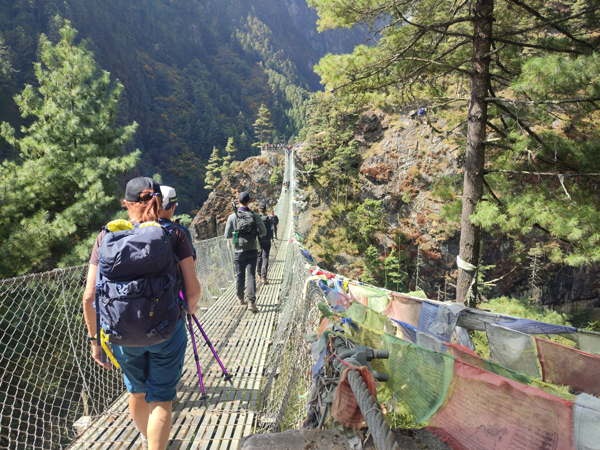
An early morning departure takes you to the airport for the flight to Lukla. Do note that during the peak seasons (spring and autumn), flights to Lukla operate from Ramechhap, which requires a pre‑dawn drive of approximately 4 hours from Kathmandu. The scenic flight takes about 15 minutes from Ramechhap (or 20 minutes from Kathmandu). From Lukla you start the Everest Three Passes trek. At first the trail descends from Lukla, following the Dudh Koshi River to the village of Phakding. The trail is quite easy-going and passes through pine forests along the river. You cross the river a few times until a final long suspension bridge brings you straight into Phakding village. At the teahouse you rest and have your first Himalayan dinner. Afterwards you go over the Everest Three Passes trek itinerary once more with the guide and plan for tomorrow’s trek to Namche Bazaar.
Overnight: a local teahouse in Phakding
Trek time: 6-7 hours
An exciting day today as you head for Namche Bazaar, also known as the Sherpa capital of the Everest region. The trail leads further along the river through a forested trail, crossing multiple suspension bridges, including the renowned Hillary Suspension Bridge. At the village of Monjo you’ll take a break to catch your breath and check in your Everest Three Passes permits. Continuing the trek, you head further uphill until the tree line disappears. At the top of the climb you’ll see on clear days a small white triangle appears above the ridge line. That’s Mt Everest! You traverse the ridge and see the horseshoe shaped village of Namche Bazaar peacefully located on the hillside. You check into the teahouse and take a well-deserved rest after a full day of trekking on the Everest trail. Dinner is served in the evening.
Overnight: a local teahouse in Namche Bazaar
Hike time: 3-4 hours
A rest day at Namche helps your body adjust to higher altitude. A morning hike to the Everest View Hotel (3,880 m / 12,723 ft) offers panoramic views of Everest (8,848 m / 29,029 ft), Ama Dablam (6,812 m / 22,349 ft), Lhotse (8,516 m / 27,940 ft), and Nuptse (7,861 m / 25,791 ft). Depending on your mood and the time you can hike further into the Khumjung Valley and visit the village, monastery, and school. In the late afternoon you return to Namche Bazaar. If you want you can explore the village and visit the Sherpa Culture Museum or the local market.
Overnight: the same teahouse in Namche Bazaar
Trek time: 6 hours
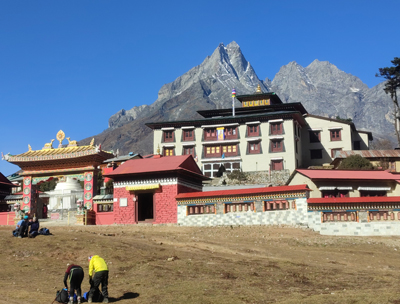
Continuing on the trail after your breakfast in Namche Bazaar you follow the route leading to Tengboche. This is where the largest Buddhist Monastery of the area is located within Buddhist territory. You bend around the Dudh Khosi river and head into the forest filled with fir and rhododendrons. Navigate the hill as you ascend towards the monastery located at top the ridge. The white walled monastery looks so peaceful with Mt Ama Dablam and Tamserku in the background under a blue sky! You check into the teahouse and explore around. Visit the monastery, participate in evening prayers or just enjoy those stunning views. On clear days you may also see Mt Everest in the distance!
Overnight: a local teahouse in Tengboche
Trek time: 5-6 hours
Today the trail descends to the Imja River, crosses a suspension bridge, and climbs through forest to Pangboche. From here you ascend again. You’ll notice that the vegetation thins out as you enter a wide valley with stone walls and a few yak pastures. Dingboche is found on a flat bench, just below Ama Dablam, surrounded by terraced fields of barley and buckwheat. Now in a more alpine mountain setting, you feel as if you are truly free! At the teahouse dinner is served and you make plans for tomorrow’s acclimatization day with your Above and Beyond Trekking guide.
Overnight: a local teahouse in Dingboche
Trek time: 3-4 hours
A second rest or acclimatization day to help your body adjust to the higher altitude. A morning hike to famous Nagarjun Hill (5,100 m / 16,732 ft) offers views of the surrounding peaks, including Makalu and Lhotse! The afternoon is free to rest, do laundry, explore the village, or visit the local bakery while enjoying the views of the Himalaya. Dinner is served at the teahouse.
Overnight: the same teahouse in Dingboche
Trek time: 3-4 hours
The trek from Dingboche to Chhukung is short enough to feel like a rest day, though the altitude makes itself known with every step! You follow the Imja Valley, a wide, flat basin framed by the peaks of Ama Dablam to the west and Lhotse to the east. The path is dusty and dry, with patches of grass and small streams crossing across the valley floor. As you trek, the views of the surrounding peaks become clearer and more direct. It’s not before long when Chhukung appears. Just a tiny settlement of a few teahouses, tucked beneath the rocky slopes that lead up to Kongma La, your first and highest mountain pass of the Everest Three Passes trek! The village feels a bit exposed and quiet, with only a handful of other trekkers around depending on the season. Tomorrow you’ll face the pass, so a pre-dawn departure is required. We suggest charging your batteries and headlights as soon as you check into the teahouse.
Overnight: a local teahouse in Chhukung
Trek time: 7-8 hours
This is the longest and most demanding day of the entire Everest Three Passes trek! The day starts long before dawn, with headlamps lighting the trail and locating your guide as you leave Chhukung. The route climbs steeply over loose moraine, with the terrain shifting from rocky scrubs and rock debris to snow as you gain more altitude. Ascending the pass is relentless, and the thin air makes every step feel heavy. But, from the top of Kongma La (5,535 m / 18,159 ft), the view stretches across the Khumbu Glacier to the peaks of Makalu, Lhotse, and Nuptse! The descent on the other side is equally hard, with a long, steep drop-down. Across loose rock and gravel before a crossing of the glacier itself. The trail eventually levels out and leads to Lobuche. By the time you arrive, your legs are tired, but the sense of achievement is strong! You did it, your first pass! Take a hearty warm dinner at the teahouse before turning in for the night.
Overnight: a local teahouse in Lobuche
Trek time: 3 hours (Gorakshep), 6 hours (EBC, up and down)
The trail to Gorakshep follows the lateral moraine of the Khumbu Glacier, with views of Pumori and Nuptse rising above the ice! You trek now on a rocky and uneven trail, and the wind can pick up as you approach the top of the moraine. In a few hours you’ll reach the last outpost before Everest. Gorakshep. You check in and bring only a day back after a quick rest and lunch. We highly advise you to prepare for tomorrow’s sunrise hike and start charging your batteries and headlights before continuing the hike to Base Camp. The route to Everest Base Camp continues across rocky terrain, with the Khumbu Icefall visible in the distance. During the climbing season, Base Camp is a tent city of expeditions, with flags and gear scattered across the glacier! At other times, it is a quiet, stark place, marked by a small cairn and the occasional prayer flag. The return to Gorakshep is a steady trek back along the same route, with the late afternoon sun casting long shadows across the glacier. Dinner is served at the teahouse.
Overnight: a local teahouse in Gorakshep
Trek time: 7-8 hours
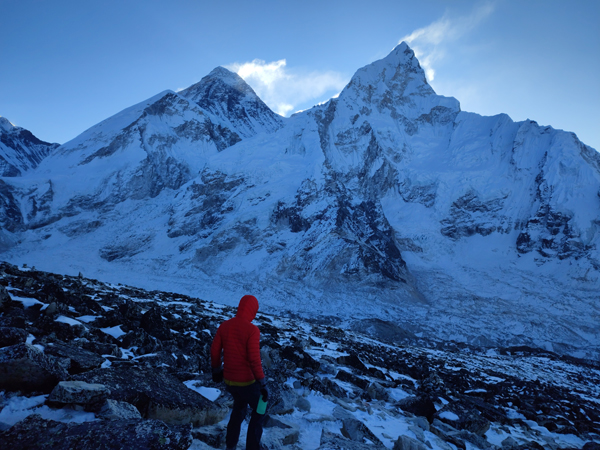
A pre‑dawn start is required for the climb to Kala Patthar, a rocky summit that rises above Gorakshep, with some of the best views of Mt Everest and its neighbours. The trail is steep and loose, and the altitude makes the climb feel harder than it looks. But the view from the top is worth the effort! As the sun rises, the light hits Everest, Lhotse, Nuptse, and Pumori in sequence, turning the peaks from grey to gold to snow glittering white. The descent back to Gorakshep is quick, and after breakfast, the trek continues down back past Lobuche and across a wide valley to Dzongla. The village is small and sits at the base of the Cho La pass, your second pass during the Everest Three Passes trek, with a few teahouses and a view back toward the peaks you trekked away from earlier in the day.
Overnight: a local teahouse in Dzongla
Trek time: 7-8 hours
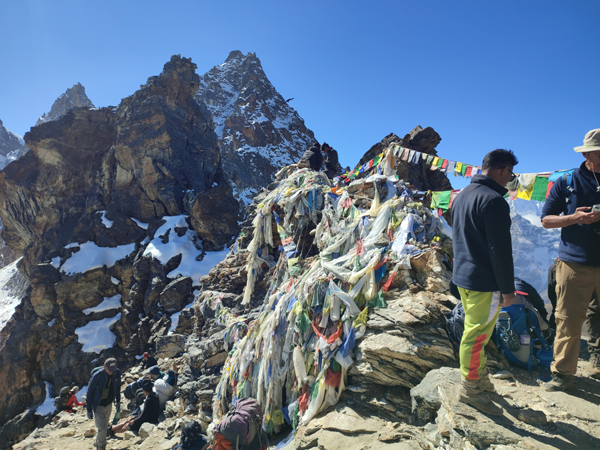
Climbing the Cho La Pass (5,368 m / 17,611 ft) starts with a steep ascent up a rocky slope, then crosses a snowfield and a glacier before reaching the pass. The snow sections can be tricky, and during the spring, fixed ropes are sometimes in place to help with the steeper sections. From the top, the view includes the peaks of Cho Oyu and the mighty Ngozumpa Glacier, the longest glacier in Nepal! The descent is steep at first, with loose rock and snow, but it gradually eases as you enter the Gokyo Valley. The first turquoise lake appears before you reach the village, and the sight of the water’s surface reflecting the Himalayas is a welcome relief after the Cho La passing. You check in and wait for a delicious dinner to be served.
Overnight: a local teahouse in Gokyo
Trek time: 3-4 hours ascent, 2-3 hours return
Gokyo Ri is a steep climb, but the reward is one of the best views in the entire Khumbu! The trail rises sharply above the village, with the turquoise lakes growing smaller as you gain height. From the summit, four of the world's highest peaks are visible in a single view: Everest, Lhotse, Makalu, and Cho Oyu. The Ngozumpa Glacier stretches out below, its surface creased with crevasses and icefalls. The rest of the day is free to explore the village, walk along the lakeshore, or simply rest in the teahouse.
Overnight: the same teahouse in Gokyo
Trek time: 7-8 hours
Renjo La (5,360 m / 17,585 ft)is the final pass of the trek, and it offers some of the most dramatic views of the entire Everest Three Passes trek! The climb is steep, with sections of loose rock and scree, but the view from the top is a wide panorama that takes in Everest, Cho Oyu, and the Gokyo Lakes far below. Descending from your last pass leads into the Thame Valley, a quieter part of the Khumbu with fewer trekkers. You wind through small villages and open pastureland, with the peaks of the region visible at every turn. By late afternoon you’ll reach at Lungden, a small settlement with basic teahouses and a peaceful atmosphere.
Overnight: a local teahouse in Lungden
Trek time: 6-7 hours
Enjoy breakfast at Lungden before hitting the trail again. Today you’ll head back to the Sherpa village of Namche Bazaar and rejoin back on the standard EBC trail. The trail follows the Thame Valley downstream, passing through forests and small villages. Follow the path steadily descending, with occasional views back toward the peaks you've crossed! The route crosses the Dudh Koshi River and then climbs the final hill back into Namche Bazaar. The town feels lively after the quiet valleys, and the cafes and bakeries are a welcome change from the high‑altitude teahouses.
Overnight: a local teahouse in Namche
Trek time: 6-7 hours
Your final trekking day follows the river now downstream back through Phakding and back to Lukla. The trail is busier than the higher sections, with trekkers heading up and porters carrying loads. Follow the safety instructions of your guide and never give way by standing on the exposed section of the trail. The descent is steady, and the air grows warmer as you lose altitude. The final part of your trekking adventure in the Everest region is a final ascent until you reach back at Lukla, marks the end of the trek, and the town has a celebratory feel as trekkers gather for meals and drinks.
Overnight: a local teahouse in Lukla
Flight: 15-35 minutes
After breakfast you head back to the airport for your flight back to Kathmandu. Do note that during peak seasons, the flight may land at Ramechhap, with a drive of several hours to the capital. A transfer takes you back to your own booked hotel in Kathmandu, and the rest of the day is free to shower, rest, and settle back into the pace of the city. We meet back up in the evening for your valuable trip review of the Everest Three Passes trek.
Overnight: Your own booked hotel in Kathmandu
About 3 hours before your flight, our Above and Beyond Trekking driver will pick you up and transfer you to the international airport. We say our goodbyes and wish you a safe flight filled with memories of Everest and its three high mountain passes!

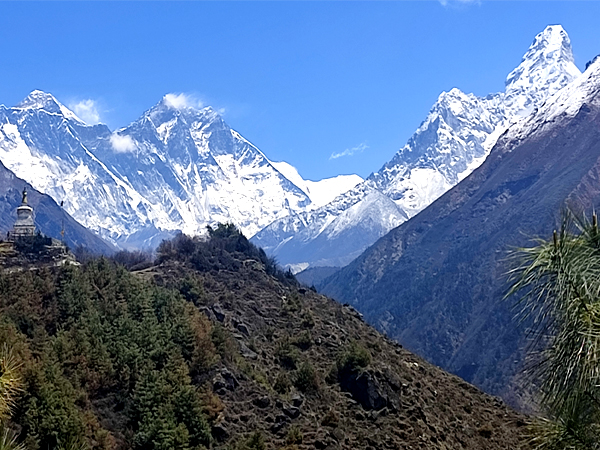

April 2, 2025
“We did the Everest Base Camp trek in April with Above & Beyond. The views were breathtaking and our guide made everything so easy and fun. Highly recommend!”
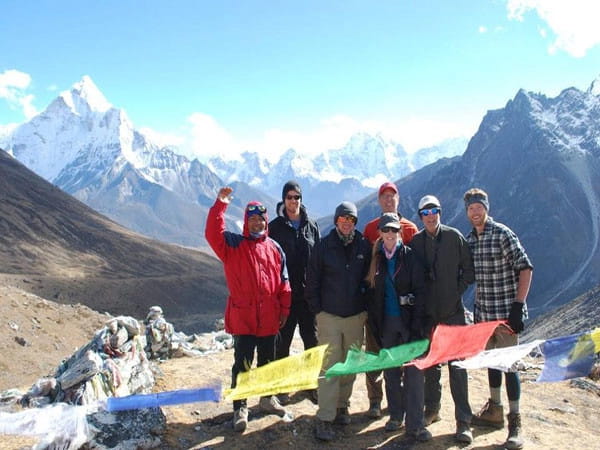
October 10, 2025
“It was a trip of a lifetime! Our guide Sam was incredibly professional, and always ensured we were safe and comfortable. I will never forget this experience”
October 12, 2025
“My trek to Everest Base Camp with Above & Beyond Trekking exceeded all expectations. Everything was well-organized from airport pickup to the final descent.”
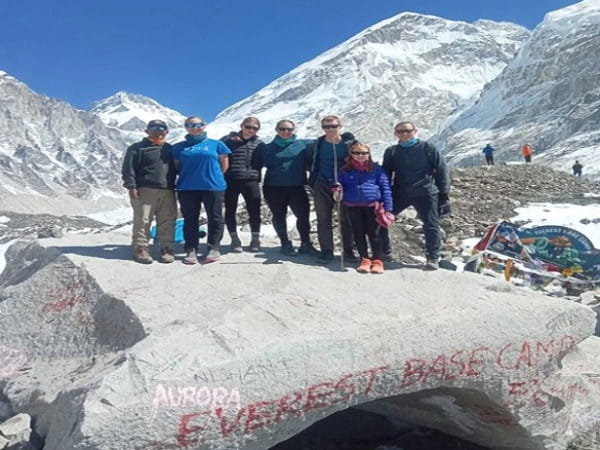
April 2, 2023
“The Everest Base Camp trek was an experience of a lifetime! And a knowledgeable guide like Sam was a definite plus. We learned so much about the Nepali culture. He took extra time to answer our questions and explain customs of the wonderful local people. All details were well worked out and logistics went smoothly. Sam was kind and gentle but also made the call when needed to get a horse for me to finish the last leg of the journey”
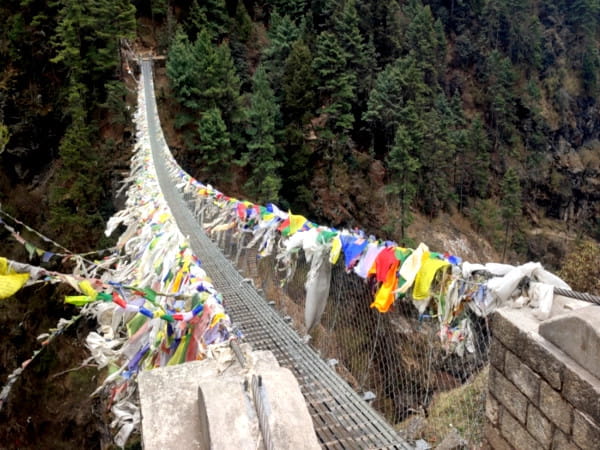
April, 2023
“Sam is possibly the best trekking guide in Nepal if not the world. Guide, porter, medic, comidian, singer he does it all! Sam is very friendly and so easy to talk too. I found it very easy to bring up any issues I had (not that I had many) which helped to make the trekking experience the best it could possibly be. Sam is very knowledgeable about the mountains and the local culture and thought us so much. Sam also chooses the best local porters. Very friendly and very helpful. Couldn't have asked for any better. I couldn't recommend above and beyond trekking more highly”
